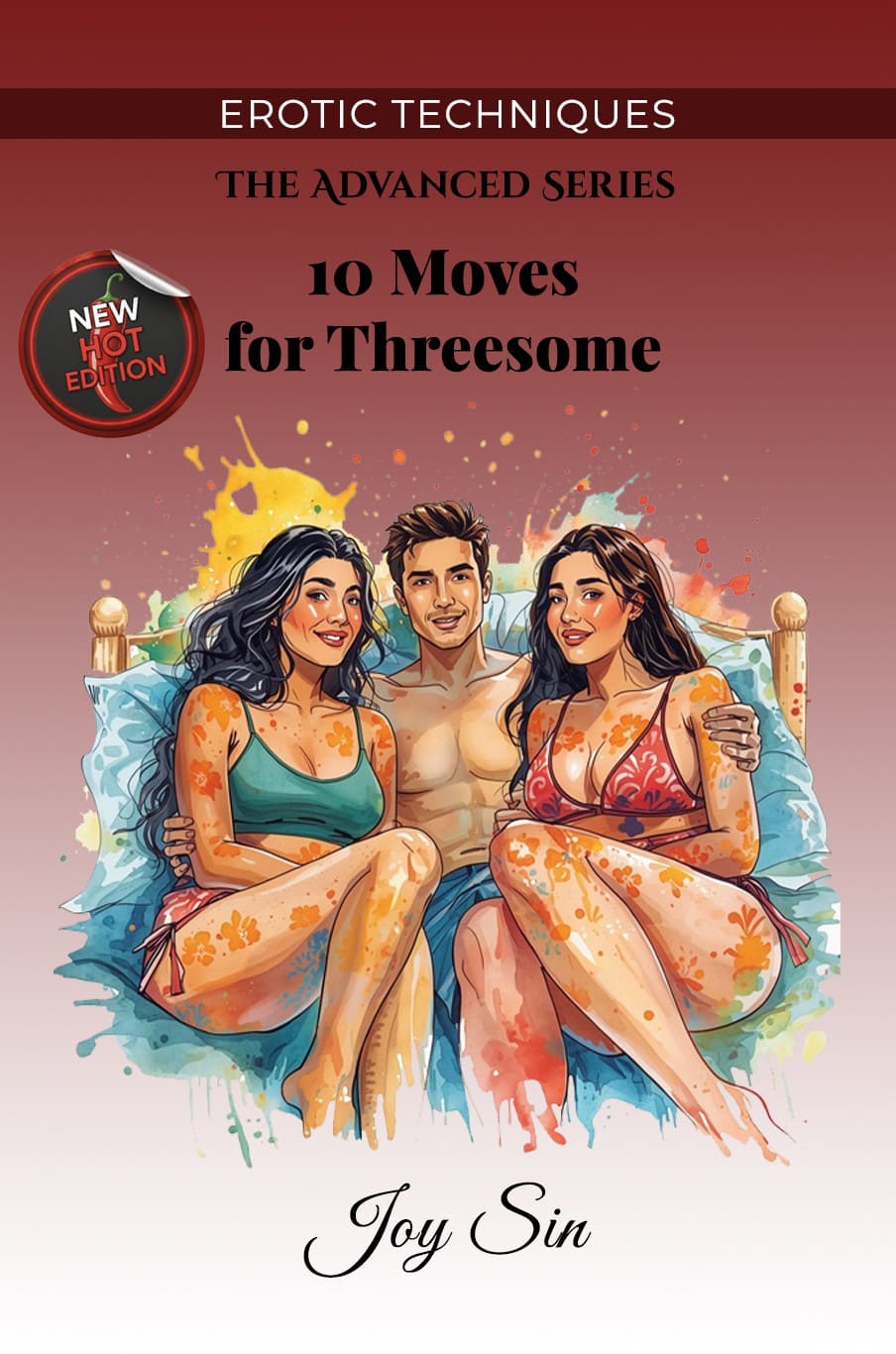
10 Moves for Threesome
How to Navigate Three Bodies, Synchronize Arousal, and Create Experiences So Intense Everyone Craves the Next Time
Three bodies. One experience. No regrets.
Inside this guide:
- The conversation that must happen first
- Finding the third — ethically and specifically
- Rules that protect without destroying spontaneity
- Attention management in a three-person dynamic
- The debrief — every couple needs this
🔒 Discreet purchase · Paperback & Kindle · Adult content
What You'll Learn
Most threesome guides tell you what to do in bed. This one starts further back — at the conversation, the agreement, the selection. The bedroom part is only as good as the foundation you built before entering it.
What No One Told You
Most negative threesome experiences have nothing to do with the sex itself. They come from inadequate screening, vague pre-agreements, and no plan for handling unexpected emotions. A threesome approached with the right orchestration framework does not threaten relationships — it deepens them. The difference between damage and transformation is entirely in the preparation.
The 10 Moves
Each move builds on the previous. Read them in sequence the first time.
- 1
Move 1 — Set the Rules Before Clothes Come Off: Boundaries established before arousal begins create permission rather than restriction. Discuss what is and is not permitted while both partners are calm, specific, and sober. Vague agreements produce vague experiences — and vague experiences produce regret. The more precise the pre-agreement, the more freedom exists within it.
- 2
Move 2 — Screen for Compatibility, Not Just Attraction: The most common selection error is choosing the third based on physical attraction while ignoring emotional intelligence. Someone who cannot read the room, cannot handle unexpected emotions, or has an agenda beyond what was agreed will transform a positive experience into a damaging one. Screen for self-awareness and flexibility — not just looks.
- 3
Move 3 — Build Anticipation Until Safety Becomes Hunger: The transition from nervous tension to genuine desire requires a specific escalation sequence. Begin with full clothes, deliberate eye contact, and gradual physical proximity. The group arousal builds together or it doesn't build at all. Rushing this phase is the second most common error — after inadequate screening.
- 4
Move 4 — Synchronize Arousal Across Three Bodies: Three people rarely reach peak readiness simultaneously. The orchestrator's role is to read all three arousal signals and adjust the pace so no one is being asked to participate before they're ready. This requires attention distributed across all three people simultaneously — a learnable skill that most first-time participants never consider.
- 5
Move 5 — Rotate Attention So No One Waits Too Long: The 2-1 rule: when two people are focused on each other, the third should never wait longer than 90 seconds without deliberate engagement. Drift — where one person transitions from participant to observer without choosing to — is the primary cause of post-session resentment. Rotation requires intention and practice.
- 6
Move 6 — Use Positions That Multiply Sensation: Geometric configuration determines who has access to whom and what simultaneous stimulation is possible. Most first-time participants default to sequential attention rather than simultaneous — one person at a time. Positions designed for three-person participation multiply sensation rather than dividing attention.
- 7
Move 7 — Communicate Without Killing the Mood: Three-person dynamics require ongoing communication that verbal narration alone cannot provide. Touch cues (a specific squeeze meaning pause), verbal guidance (brief, directive, not explanatory), and non-verbal signals established in advance allow real-time adjustment without breaking the erotic state that makes everything work.
- 8
Move 8 — Navigate Mismatched Rhythms and Unexpected Emotions: Jealousy, arousal imbalance, and unexpected emotional responses occur in most first experiences regardless of how well the pre-agreement was constructed. The difference between experiences that damage relationships and those that deepen them is not the absence of these responses — it is having a protocol for addressing them without full stop.
- 9
Move 9 — Layer Sensations So Intensity Compounds: Simultaneous stimulation from multiple sources creates compound sensations not available in two-person sex. Dual stimulation — two people attending to one simultaneously, or one person receiving stimulation from two directions — produces intensity that scales beyond what either contributor could produce independently. This is the primary physical distinction of a well-orchestrated threesome.
- 10
Move 10 — Close So Everyone Craves the Next Time: The closing sequence determines whether the experience integrates positively or leaves unresolved emotional residue. Aftercare for three people has specific requirements beyond two-person aftercare: each person needs to feel seen as an individual, not just a participant. The debrief — ideally 24 hours later, not immediately after — is what converts a good experience into a foundation.
For When the Basics Aren't Enough
These guides assume you already know your way around a bedroom — and want more.
Advanced, not extreme
Each technique pushes past ordinary — role-play, foreplay, oral, anal, toys — without needing anything you don't already have.
Built for variety
Six distinct techniques, each with its own logic. Rotate them, combine them, make them yours.
Confidence over improvisation
Every guide replaces guesswork with a sequence that's been tested to actually land.
Nothing is glossed over
The moments other guides skip — negotiating a threesome, prepping for anal, holding foreplay past the obvious — are exactly what's covered here.
This Guide Is For You If…
- ✓Couples who want to explore threesomes but don't know how to start safely
- ✓Anyone who has had a mediocre or damaging threesome experience and wants to understand what went wrong
- ✓People willing to treat threesome facilitation as a learnable skill rather than luck or improvisation
- ✓Partners where one wants to explore and the other needs a framework to feel genuinely safe doing so
- ✓Those ready to invest attention and precision into mastering the most complex consensual dynamic in partnered sex
From Page to Practice
Three steps. No ceremony.
Read it completely first
Don't skip ahead. The moves build on each other — reading in sequence gives you the full picture before you act.
Apply move by move
Use the moves in order the first time. Each one sets up the next. After that, you can adapt freely.
Come back to it
Re-read after you've applied it. You will notice things you missed the first time — this is by design.
Inside the Guide
What Readers Say
Verified Amazon purchases.
"I thought I just needed to "communicate better." This guide showed me I was missing the entire orchestration framework. The screening section alone changed everything — we'd been selecting for the wrong qualities entirely."
Verified Purchase
"We tried a threesome once before and it created so much tension we never talked about it again. After following these moves, we finally had the experience we'd hoped for — and everyone actually wants to do it again."
Verified Purchase
"This is the only guide that treats threesomes as the complex psychological and relational skill they actually are. Not "just find someone willing" — real facilitation technique. Move 8 on unexpected emotions saved our relationship from a situation we weren't prepared for."
Verified Purchase
More Guides in This Collection
Each guide in the series covers a different topic with the same level of precision.
Questions About This Guide
How explicit is the content?
Very explicit. The guide uses anatomically correct language, names body parts directly, and describes sexual techniques with full detail. It is written for adults who want real guidance.
Is this suitable for beginners?
Yes. The guide starts from fundamentals and builds progressively. No prior experience is assumed — though the techniques are equally valuable for those with more experience.
Paperback or Kindle — which should I get?
Both are available on Amazon. Kindle delivers instantly and is completely discreet. Paperback is better for repeated reference. Choose based on your preference.
How long is the guide?
Short enough to read in a single sitting — typically 60–90 minutes. Length is a feature, not a flaw: there is no filler, no padding, no repeated content.
Does it only apply to heterosexual couples?
Each guide specifies its context clearly. Most techniques in this series are adaptable across gender combinations — the guide notes where specific anatomical considerations apply.

Get the Guide Tonight
Available on Amazon in paperback and Kindle. Discreet purchase and shipping.
🔒 Secure checkout · Instant Kindle delivery available